
Hydrojetting vs Snaking: Choosing for Limão Commercial Drains
It is closing time at a lunch counter on Rua Coronel Euclides Machado, and the sink is draining slower than it did last week. The owner has a choice: call a technician with a mechanical snake or bring in a team with a high-pressure hydrojetting unit. For grease-heavy commercial drains in the Bairro do Limão, that choice matters more than most people think. A desentupidora em Bairro do Limão São Paulo SP that operates both methods can explain the difference before anyone puts a cable in the pipe.
This article is written for restaurant, bakery, and small commercial kitchen owners who need a technical reason to pick one method over the other. It covers how each technique works, the pressure ranges involved, and the situations where high-pressure washing clearly beats a mechanical snake.
Why Limão’s Commercial Strips Stress Drains Differently
The Bairro do Limão sits in the northern zone of São Paulo, close to the Tietê and Marginal roads, and its commercial streets are lined with lunch counters, pastelarias, bakeries, and small restaurants. Many of these kitchens share older clay or cast-iron waste lines with residential buildings above or beside them. That mix of heavy grease from food service and aging pipe material creates a specific kind of blockage.
Grease does not simply sit in one spot. Hot fat cools as it travels, coats the pipe wall, and traps food particles, soap residue, and paper fibers. Over months, the layer hardens into a soap-like crust that narrows the pipe’s inner diameter. A snake can punch a hole through that crust, but it rarely removes the coating. This is why a drain that is snaked in January often backs up again by March.
Commercial strips also produce more volume than residential kitchens. A single lunch rush can push dozens of liters of oil-laden water through a four-inch line in a few hours. When several establishments share a building’s main branch, the grease load compounds. That is the context in which a desentupidora Bairro do Limão São Paulo SP team typically recommends assessing the entire line, not just the sink trap.
How a Mechanical Snake Works and Where It Falls Short
A mechanical snake, also called a drain auger, is a flexible steel cable with a cutting head at the tip. The technician feeds it into the drain and rotates it by hand or with a motor. The head breaks through soft blockages, hooks hair or rags, and can scrape some material from the pipe wall. It is a proven tool for toilets, floor drains, and short runs where the blockage is a solid object or a localized clog.
Advantages of snaking
- Fast setup for simple, reachable clogs.
- Effective on solid obstructions like wads of paper, hair, or small objects.
- Lower equipment cost, which can translate into a lower initial service price.
- Works well in tight spaces where a pressure hose cannot be routed.
Limitations in grease-heavy kitchens
The snake’s weakness is that it creates a channel rather than cleaning the pipe. In a restaurant line coated with grease, the cutting head opens a passage roughly the size of the cable. Water flows again, but the coating remains and continues to trap debris. Within weeks, the channel narrows and the drain slows again. Snaking also does not reach the full circumference of the pipe, so grease on the upper walls stays untouched.
There is another risk. An aggressive snake in old cast-iron or clay pipe can catch on a rough joint or a root intrusion and crack the material. In Limão’s older buildings, that turns a routine unclogging into a repair job.
How Hydrojetting Cleans the Full Pipe Wall
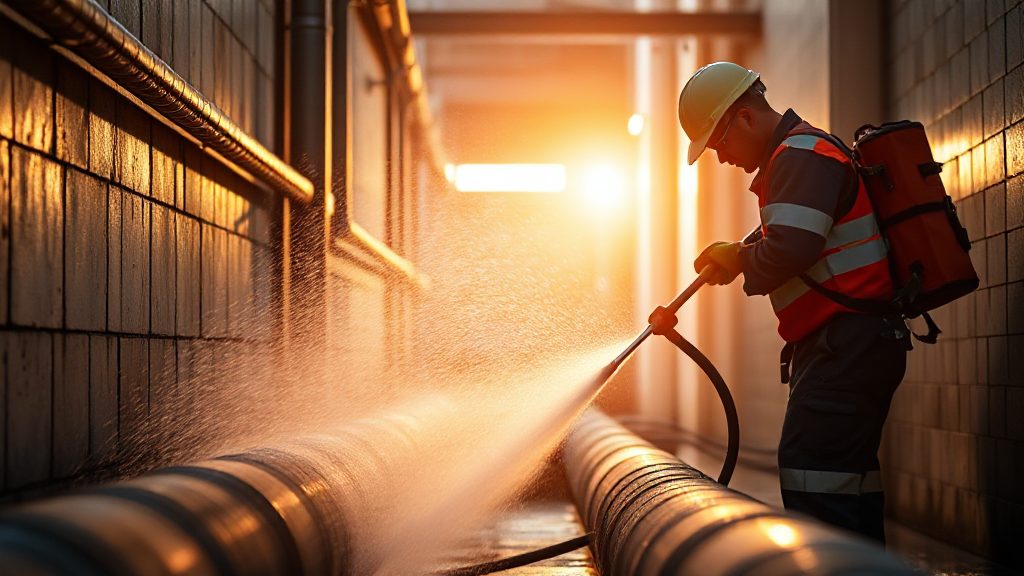
Hydrojetting uses a high-pressure water stream delivered through a specialized hose with a forward and rear-facing nozzle. The forward jet cuts through the blockage, while the rear jets pull the hose forward and flush debris back toward the access point. The result is a 360-degree scouring action that removes grease, scale, sand, and sludge from the entire inner surface.
Pressure ranges and what they mean
Commercial hydrojetting units typically operate between 1,500 and 4,000 PSI, with flow rates that can exceed 15 gallons per minute. The exact setting depends on pipe material and condition. A technician will use lower pressure on older cast iron or clay and higher pressure on modern PVC or concrete lines. This is not a one-size-fits-all operation; the wrong pressure can damage a fragile pipe.
The equipment itself is heavier than a snake. A hydrojetting truck or trailer carries a water tank, a high-pressure pump, and a hose reel. That is why the service usually requires driveway or street access and a technician who can assess the line before starting.
What hydrojetting removes that snaking cannot
- Hardened grease and soap crust along the full pipe circumference.
- Sand, silt, and scale that accumulate in low spots.
- Root hairs and organic matter in outdoor lines.
- Odor-causing biofilm that clings to the pipe wall.
For a commercial kitchen, the difference is measurable in time between backups. A properly hydrojetted line typically stays clear longer because there is no residual coating for new grease to bond to.
When High-Pressure Washing Beats a Snake in Limão
The decision matrix below is the practical part of this article. Use it as a starting point, but confirm with a technician who can inspect the line.
| Situation | Better first choice | Why |
|---|---|---|
| Single sink or toilet clog with a solid object | Mechanical snake | Fast, targeted, and low-cost for a localized obstruction. |
| Restaurant grease line with recurring slowdowns | Hydrojetting | Removes the full-wall grease layer instead of punching a hole. |
| Shared building main with multiple food businesses | Hydrojetting plus camera inspection | Confirms the entire branch is clean and identifies damaged sections. |
| Old cast-iron or clay pipe with known cracks | Camera first, then low-pressure jetting or snake | Prevents further damage; method depends on pipe condition. |
| Outdoor line with sand, roots, or sludge | Hydrojetting | Flushes debris that a cable cannot pull out. |
For most Limão lunch counters and bakeries, the pattern is predictable: the first clog gets snaked, the second clog gets snaked again, and the third one finally prompts a call for hydrojetting. Skipping the first two steps usually saves money. A quanto custa desentupir pia em Bairro do Limão conversation with a local provider can clarify whether the line is a candidate for jetting before the next busy weekend.
Preventing Grease Rebuild-Up After the Service
Hydrojetting resets the pipe to a clean state, but it does not stop new grease from arriving. The owner’s habits determine how long the result lasts. Three practices make the biggest difference in a commercial kitchen.
- Install and maintain a grease trap sized for the kitchen’s volume, and pump it on a schedule before it fills.
- Scrape plates and pans into solid waste before washing, so less fat reaches the drain.
- Schedule preventive hydrojetting every six to twelve months on high-volume lines, rather than waiting for a backup.
Preventive service is usually cheaper than emergency service because it can be planned during off-hours and does not involve a flooded kitchen at peak time. For shared buildings, a maintenance agreement among the commercial tenants spreads the cost and keeps the main branch clear.
Choosing a Provider and Planning the Next Step
Not every drain service in São Paulo carries hydrojetting equipment, and not every technician who owns a snake can safely operate a high-pressure unit. Ask three questions before booking: does the provider have a camera for inspection, what pressure range do they use on your pipe material, and do they offer preventive scheduling? A provider that answers these clearly is better prepared for a commercial kitchen than one that only quotes a flat unclogging fee.
For a Limão business owner, the practical path is straightforward. If the drain is slowing for the first time and the blockage feels localized, a snake may be enough. If the slowdown returns within a few weeks, or if the kitchen handles heavy frying oil, hydrojetting is the more durable choice. The right provider will inspect before deciding, explain the pressure they plan to use, and leave the line clean enough that the next lunch rush is not a gamble.